As Iran is currently weighing whether or not to go to full scale war with or repeatedly retaliate against Israel for the assassination of Hezbollah’s chief Hassan Nasrallah, the US and Israel should make it possible for Tehran not to retaliate without losing face and potentially avert further escalation of the conflict if not a regional war.
By Dr. Alon Ben-Meir
Following the assassination of Hezbollah’s Secretary-General Hassan Nasrallah, a key Iranian proxy, the Iranian government is now facing perhaps one of the most consequential decisions. Whether or not to go to full scale war with Israel or repeatedly retaliate for Nasrallah’s death will have a dramatic effect on Iran’s domestic and international standing. For this reason, Iran will not react precipitously and will weigh the pros and cons carefully before making its final decision. While Iran is deliberating over its predicaments, the US and Israel should act in a manner that would discourage Iran from retaliating without losing face and prevent further escalation of the conflict rather than potentially risk a regional war.
Support for Retaliation
Some top Iranian officials and military commanders argue that it is critical for Iran to maintain its deterrence against Israel and prevent future Israeli strikes on Iranian assets and its allies. Thus, it must retaliate, as not responding could be seen as a sign of weakness that emboldens further Israeli actions. These hard-liners have recently grown dissatisfied with the country’s inability to counter Israeli strikes effectively and are now pushing for a more aggressive response.
Besides, given that Nasrallah was a long-time, high-value partner for Iran in the region, his death, along with other top Hezbollah leaders, is increasing the pressure to retaliate because they want to demonstrate their commitment to defending Iran’s proxies and allies. Moreover, Iran’s supreme leader has framed the conflict in ideological terms, calling for Muslim solidarity against Israel. And finally, the Iranian mullahs want to convey to the Sunni Muslim world that Shi’ism is not in retreat and that Iran supports fellow Shias, especially Hezbollah, on which Iran relies as the first line of defense against Israel should a war break out with Israel and the US decides to enter the fray.
The Risks of Retaliation
Notwithstanding the argument’s soundness in favor of retaliation, Iran faces significant risks of reprisal, including the possibility that it could lead to a broader regional conflict with severe consequences that Iran wants to avoid, which could provoke a confrontation with the United States and threaten the regime’s hold on power. Iran is further concerned that its military capabilities, particularly its air force and air defenses, are outdated compared to Israel’s far advanced capabilities.
Moreover, Iran does not want to be humiliated again by firing several hundred missiles, as it had as a response to the Israeli attack on its military compound in Syria, only to be intercepted by Israel and its allies. Even more importantly, Iran wants to prevent Israel from attacking its nuclear industrial complexes and prevent it from acquiring nuclear weapons if it becomes necessary to deter future attacks on its soil.
What further concerns Iran is its economy, which is already struggling under sanctions and cannot afford further economic fallout from a major conflict. Further escalation could bring additional sanctions, which Iran cannot afford, especially amidst existing internal dissent. Finally, given that Israel has nearly decimated Hamas’ and degraded Hezbollah’s military capabilities, Iran prefers to rebuild and restabilize Hezbollah and help Hamas reconstitute itself for its long-term strategy against Israel.
Benefits of Not Retaliating
By not retaliating, Iran could position itself as a responsible actor seeking a diplomatic solution to regional tensions. Iran may want to give the ongoing ceasefire talks in Gaza a chance to succeed, which could benefit Hamas, help de-escalate the broad regional conflict and allow it to claim that its threat of retaliation helped bring about regional stability.
Besides avoiding further economic strains, Iran wants to maintain diplomatic channels open for possible negotiations or de-escalation efforts, positioning itself as a responsible actor seeking diplomatic solutions and potentially improving its international standing. Staying out of a direct conflict would protect its nuclear program from potential attacks. Iran’s leadership can also focus on addressing internal economic and political challenges, allowing it to reassess its regional strategy and proxy network without mounting pressure.
Iran’s Supreme Leader and his high liners
Supporting Iranian President Pezeshkian’s Agenda
Non-retaliation could support President Pezeshkian’s stated desire to normalize relations with the world and pursue constructive engagement on the international stage. He declared in his General Assembly speech his willingness to establish, as he said, “a strong foundation for my country’s entry into a new era, positioning it to play an effective and constructive role in the evolving global order,” and emphasized, “We want peace for all and seek no war or quarrel with anyone.” In a July Tehran Times op-ed, Pezeshkian expressed interest in “engaging in constructive dialogue with European countries to set our relations on the right path.”
He expressed readiness to engage with the signatories of the 2015 nuclear deal (Joint Comprehensive Plan of Action, JCPOA) and defended the agreement, stating that if the deal’s “commitments are implemented fully and in good faith, dialogue on other issues can follow.” In July, Pezeshkian stated that “Iran’s defense doctrine does not include nuclear weapons.” He also urged the United States in July to “learn from past miscalculations and adjust its policy accordingly.”
Although Iran prefers not to retaliate, its ultimate decision will depend on what the US and Israel do next, as long as non-retaliation allows it to reap some benefits without losing face.
The US’ Challenging Task
Although the US is on the cusp of presidential elections, President Biden still has four months left in his term. Much can happen during this period, during which he can set the tone and make critical decisions with long-term regional implications. Biden was correct in warning Iran not to escalate the violence while further augmenting US forces in the region to deter Iran from retaliating.
Biden should also signal that he is pleased with Pezeshkian’s desire to “engage in constructive dialogue” and that the US would welcome renewed negotiations aimed at reviving the 2015 nuclear deal and setting Iran’s relations with the West on the right path, as Pezeshkian stated. This will be of great importance to Ayatollah Khamenei, who will view this as a goodwill gesture and a sort of ‘win.’ It would go a long way toward calming the atmosphere.
Israel’s tactical win is short-lived
Whereas Netanyahu is basking in Israel’s success in the killing of Nasrallah, he still has no exit strategy from Gaza or a plan to end the hostilities in Lebanon. Netanyahu’s foremost concern remains his political survival, and he still fails to understand that decapitating Hamas and Hezbollah’s leaders will not end the conflict with either group.
A new generation of fierce, ruthless, and vengeful leaders will rise, and though they know they cannot destroy Israel, they can deprive it of a day of peace. These groups will withstand any Israeli onslaught in the future, Iran will become even stronger, and it may well accelerate the production of a nuclear weapon to deter any enemy from attacking it, which is precisely what Netanyahu wants to prevent.
Iran is and will continue to be a key player in the region; the US should signal its willingness to chart a new constructive path that would lead to reconciliation between the two countries. Netanyahu should not push his luck. Israel’s intelligence capabilities and technological advantages have their limits. He should not push Hezbollah to the brink and force Iran to enter the fray.
This crisis offers a rare opportunity to set the region on a new course and avert a regional war, especially if Iran is willing to play a constructive role, as President Pezeshkian articulated. Biden should put him to the test and warn Netanyahu that he must fully cooperate in a strategy to end the conflict before it’s too late.
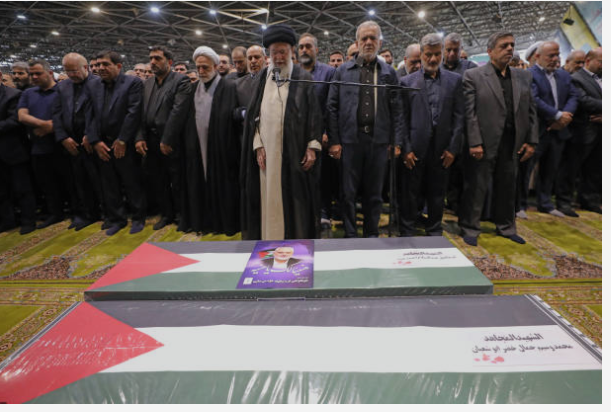
Iran’s Supreme Leader with his high liners