By Esther Edoh
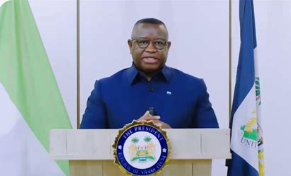
Freetown, Sierra Leone – As President Julius Maada Bio nears the end of his second and final term, Sierra Leone stands at a critical juncture, reflecting on a presidency marked by ambitious development goals, persistent economic headwinds, and allegations that have cast a long shadow. Bio, a former military leader who transitioned to civilian rule, promised a new era for the West African nation. His legacy, however, is likely to be a complex tapestry woven with threads of progress, significant challenges, and enduring controversies.
From Soldier’s Boots to Presidential Palace: A Transformative Journey
Bio’s ascent to the presidency is a narrative of profound transformation. A decorated army general, he led a brief military junta in 1996 before voluntarily handing over power to a civilian government. This act, at the time, was lauded as a crucial step towards democratic consolidation. Years later, he re-emerged on the political scene, this time as a civilian leader, winning the presidency in 2018 and securing re-election in 2023. This transition from a military strongman to a democratically elected president is a defining element of his personal legacy, showcasing a capacity for adaptation and a commitment to democratic processes, at least in his electoral victories.
The Promise of ‘Big Five’ Development
Central to President Bio’s agenda has been the “New Direction” manifesto, prominently featuring his “Big Five Game Changers”: Free Quality Education, Economic Diversification, Women’s Empowerment, Youth Employment, and Strengthening Governance. The flagship initiative, Free Quality Education, has seen significant investment, aiming to provide universal access to primary and secondary schooling. Proponents argue this has opened doors for countless Sierra Leoneans, promising a more educated and skilled future workforce.
Beyond education, his administration has pushed for economic diversification, seeking to move away from over-reliance on diamond exports. Investments in agriculture, tourism, and the development of infrastructure have been key components. Policies aimed at empowering women, through legislative reforms and increased representation, have also been a noted focus. Furthermore, initiatives to create youth employment and strengthen governance structures, including anti-corruption drives, were and have been central to his campaign promises and governance strategies.
As Sierra Leone continues its journey of post-conflict reconstruction and development, a growing consensus among political observers and citizens alike suggests that President Julius Maada Bio is carving out a unique place in the nation’s history. His tenure, characterized by a bold embrace of transformative policies and a forward-looking vision, positions him to be remembered as arguably the most innovative and progressive leader since the country gained independence.
From the moment he first took office, President Bio signaled a departure from conventional approaches, prioritizing initiatives designed to fundamentally reshape Sierra Leone’s human capital and economic landscape. At the heart of his progressive agenda is the flagship “Free Quality Education” (FQE) initiative. Launched early in his first term, FQE has dramatically expanded access to education from pre-primary to senior secondary levels, removing financial barriers for millions of Sierra Leonean children. This program is not merely about access; it’s a foundational investment in human capital, aiming to equip a new generation with the skills needed for a 21st-century economy, particularly focusing on gender parity in enrollment. Many see this as an unprecedented commitment to long-term national development.
Beyond the classroom, President Bio’s administration has championed digital transformation as a cornerstone of national development. Initiatives aimed at digitalizing government services, fostering a nascent tech ecosystem, and improving internet penetration underscore a commitment to leveraging technology for efficiency, transparency, and economic growth. This focus on a “digital Sierra Leone” reflects an innovative approach to governance, seeking to leapfrog traditional development hurdles and integrate the nation more deeply into the global digital economy.
Further solidifying his progressive credentials, the Bio administration has pursued policies designed to foster economic diversification and social inclusion. Efforts to empower women through legislative frameworks like the Gender Empowerment Act, support for youth entrepreneurship, and a renewed focus on agricultural self-sufficiency demonstrate a holistic approach to national development. These initiatives aim not just for economic growth, but for equitable distribution of opportunities, a hallmark of progressive governance that seeks to uplift all segments of society. The push for local content in industries and a more robust private sector engagement also points to an innovative strategy for economic resilience.
Navigating Stormy Seas: The Persistent Challenges
Despite these aspirations and relative progress, President Bio’s tenure has been fraught with significant socio-economic challenges. Sierra Leone remains one of the poorest countries in the world, grappling with high inflation, unemployment, and food insecurity. The global economic downturn and domestic economic mismanagement have exacerbated these issues, leading to widespread public discontent.
Infrastructure development, while a stated priority, has often been hampered by funding constraints and logistical hurdles. The promise of economic transformation has yet to fully materialize for the majority of the population, with many struggling to feel the tangible benefits of the government’s policies. The persistent reliance on foreign aid and the nation’s debt burden continue to pose significant obstacles to sustainable development.
Shadows of Controversy: Scandals and Allegations
President Bio’s legacy is also indelibly marked by a series of unproven scandals and allegations that have fueled public criticism and raised questions about accountability and transparency. Concerns regarding alleged corruption within government institutions have been a recurring theme. Reports and accusations of mismanagement of public funds and the awarding of contracts have led to calls for greater scrutiny and independent investigations.
Furthermore, allegations of human rights abuses and the suppression of dissent have drawn international condemnation. Incidents of heavy-handed responses to protests and restrictions on freedom of speech have tarnished the image of his administration and raised concerns about the trajectory of democratic freedoms in Sierra Leone. These controversies have created a narrative of a government struggling to balance its development ambitions with the fundamental principles of good governance and human rights.
The Question of Succession: Who Will Carry the Torch?
As President Bio’s term draws to a close, the question of his successor looms large. The ruling Sierra Leone People’s Party (SLPP) will need to select a candidate who can build upon his achievements, address the persistent challenges, and navigate the turbulent political landscape. Several figures within the SLPP are often mentioned as potential contenders, each with their own strengths and weaknesses. The ability of the party to unite behind a strong and credible candidate, and the effectiveness of the opposition in presenting a compelling alternative, will be crucial in shaping Sierra Leone’s political future.
A Legacy in the Making, Yet to Be Fully Defined
In conclusion, President Julius Maada Bio’s legacy in Sierra Leone is far from settled. He will be remembered as a leader who emerged from the military to embrace civilian democracy, who championed ambitious development goals like Free Quality Education, and who sought to modernize the nation. However, his tenure has also been defined by persistent economic struggles, unresolved corruption allegations, and concerns over governance and human rights.
The enduring symbol of his presidency will likely be one of duality: a period of attempted progress and significant strides in some areas, juxtaposed against the harsh realities of economic hardship and the shadows of controversy. The ultimate judgment of his legacy will depend on how history interprets the balance between his stated intentions and their tangible impact on the lives of ordinary Sierra Leoneans, and the path forward he leaves for the nation.
While the full historical judgment of any leader’s tenure can only be made with the passage of time, the breadth and ambition of President Bio’s policy agenda – from universal education and digital transformation to social equity and economic diversification – strongly suggest he is setting a new benchmark for leadership in Sierra Leone. His administration’s willingness to tackle long-standing systemic issues with fresh, often audacious, strategies has earned him accolades from various international bodies and development partners.
As President Bio continues his second term, the sustained implementation and long-term impact of these transformative efforts will be keenly observed. However, if the foundational changes he has initiated bear sustained fruit, President Julius Maada Bio may well be remembered as the visionary who truly propelled Sierra Leone into a new era of innovation and progress, making his name synonymous with a period of profound national transformation.